

Santuario de los Cactus
The Santuario de los Cactus Baja California is the most overlooked ecological treasure on the peninsula. Every visitor photographs the arch at Land’s End. Almost nobody drives inland to stand beneath a cardón that was already centuries old when Cortés first sailed into the Gulf. Furthermore, that oversight says something about how we see Baja, and what we risk missing entirely.
What Is the Santuario de los Cactus?
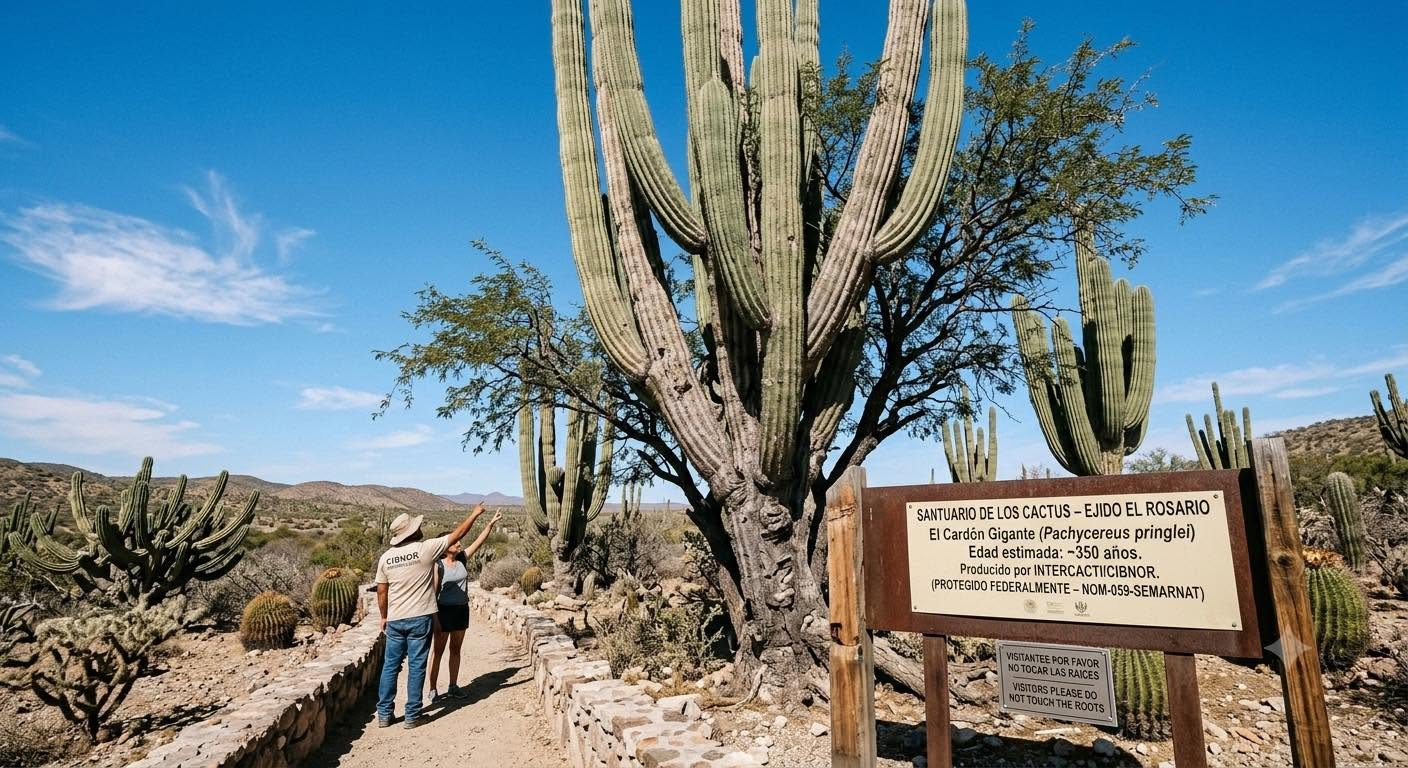
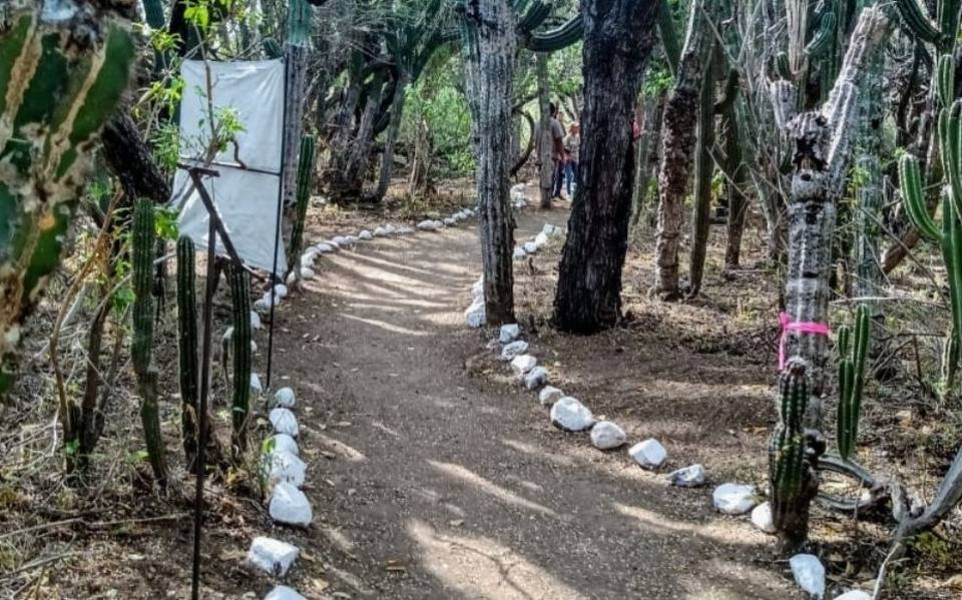
The sanctuary is not a sprawling, unmanaged wilderness. Instead, it is engineered restraint. Six hectares of fenced land, threaded with stone-lined interpretive trails built for wandering rather than trampling. Beyond that core, a 48-hectare buffer zone stands watch, keeping the native flora exactly as it has existed for a thousand years. No agriculture. No sprawl. Just desert doing what
desert does.
How Was the Sanctuary Created?
The story behind the fences matters as much as what grows inside them. In the mid-1990s, the international research group INTERCACTI, led by Mexican biologists Dr. Héctor Nolasco Soria and Dr. Fernando Vega Villasante working alongside CIBNOR in La Paz, identified something remarkable in this stretch of desert. They found an unusually dense, biologically unique
concentration of arborescent cacti.
Consequently, rather than fencing it off from the community, the scientists partnered with one. The land belongs to Ejido El Rosario. Instead of clearing it for farming, the ejidatarios became its permanent guardians, a role they have held since the sanctuary opened on Earth Day, 1997. Today the same families who could have planted crops here instead run the gate, maintain trails built from native fan palm and dried cardón rib, and guide visitors through a forest their grandparents chose to protect.
What Species Grow Inside the Sanctuary?
The cardones earn their top billing, but the sanctuary holds more than 50 distinct cactus species spanning the full evolutionary arc of the desert.
The showpiece is the Cardón Barbón, Pachycereus pecten-aborigenum, found only in the Cape region and named for the dense, bristly fruit it produces, which local indigenous groups once used as combs. Nearby, garambullos reach over 25 feet with branches so heavy they sag under their own weight. At ground level, centuries-old biznagas and stands of light-catching cholla fill in the understory.
What Is the Nurse Tree Relationship?
The detail that stops most first-time visitors is the relationship between cacti and the desert’s mezquite and palo verde trees. A cactus seedling is fragile and easily scorched by the sun. Therefore, it germinates in the shade of a legume tree and spends its first decades growing up through the canopy, using the branches as scaffolding.
Only after years of protection does it finally break through and claim the skyline. Walk the trails and you see this at every stage: young cacti still nested inside their nurse trees, and giants standing alone, the tree that raised them long since gone.
Why Does the Santuario de los Cactus Matter for Los Cabos Real Estate?
This is not just a nature story. It is a preview of how development in Los Cabos and La Paz is legally required to treat old-growth desert. Many specimens inside the sanctuary are estimated between 200 and 500 years old. Furthermore, they are protected under federal law through NOM-059-SEMARNAT.
The model Ejido El Rosario built here, cataloging, integrating, and building around irreplaceable flora rather than clearing it, has become something close to a blueprint. The next time you walk a master-planned community in Los Cabos and notice a 300-year-old cardón standing untouched in the middle of a fairway or a driveway roundabout, you are looking at this same philosophy in practice.
KT, Your Insider Guide
The beaches will always get the postcards. However, if you want to understand what Baja California Sur actually protects and why, the cactus sanctuary is where the story lives. Additionally, for buyers evaluating land or communities in the Los Cabos corridor, understanding this legal and ecological framework changes how you read every development site plan you review.
The desert is not the backdrop. It is the asset.
Discover the land and lifestyle of Baja California Sur at cabosfinest.com