

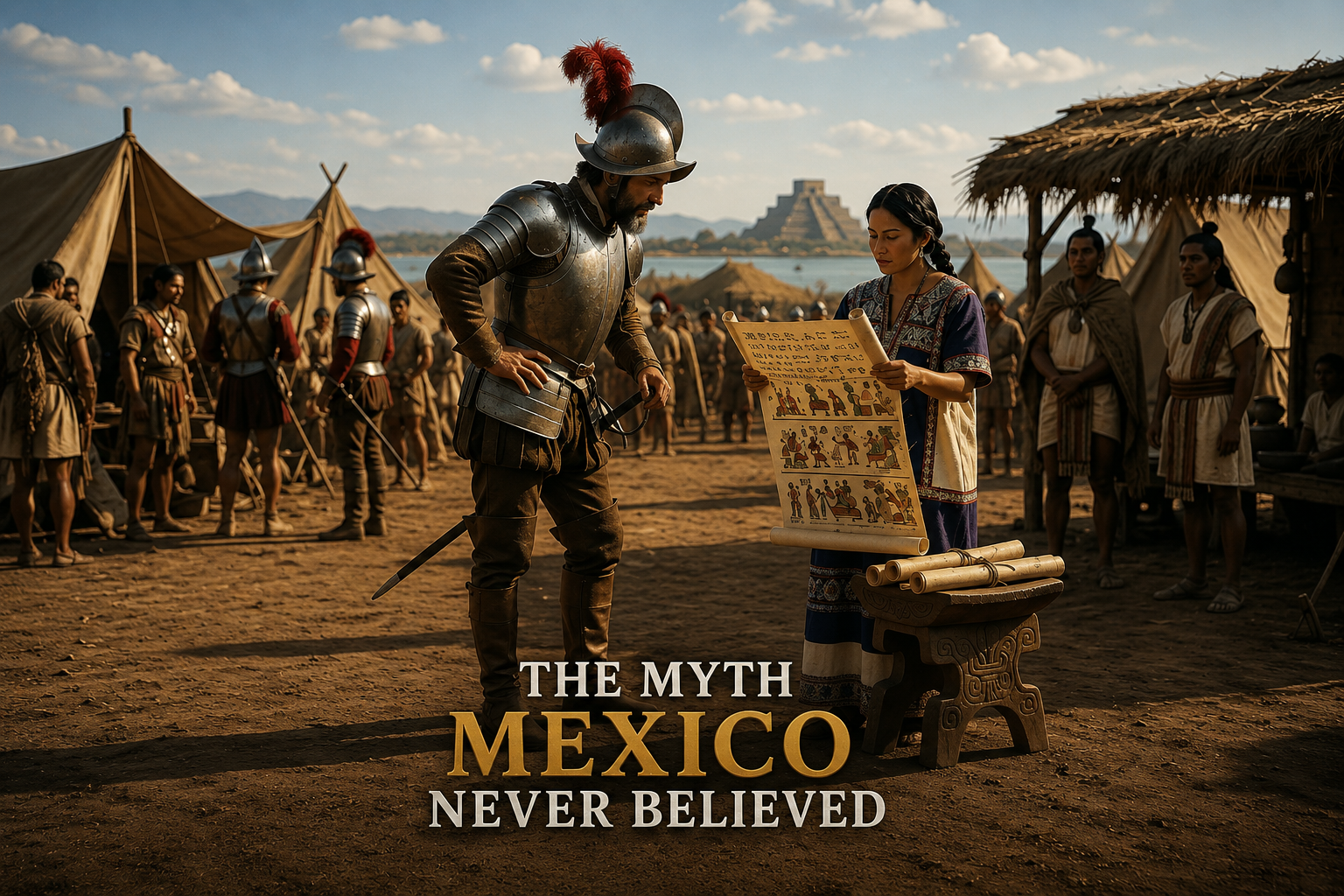
Cortés, the Myth Mexico Never Believed
Cortés, the myth Mexico never believed, tells a very different story than the one most textbooks repeat. The legend says a lone genius marched five hundred men into an empire and bent it to his will. Mexico has never accepted that version, and for good reason.
Here is what actually happened.
An Alliance, Not a Conquest
Cortés did not conquer the Mexica. An alliance of indigenous nations did, and they used Cortés as the weapon to do it. The Tlaxcalans had spent generations under Mexica taxation and terror, so when a bearded foreigner arrived with steel, gunpowder, and an obvious talent for chaos, they made a cold, calculated decision. They would use him.
By the time Cortés laid siege to Tenochtitlan, a brutal ninety-three-day campaign, he commanded somewhere north of eighty thousand indigenous allies. So the famous “five hundred Spaniards” were never conquering anything on their own. Instead, they served as the catalyst inside someone else’s war of liberation.
The Enemy Nobody Talks About
Disease, however, did more damage than any soldier.
When the Mexica drove the Spanish out of Tenochtitlan during La Noche Triste, Cortés retreated to Tlaxcala to regroup. But he left something behind: smallpox. Because the indigenous population had no immunity and no defense, the virus spread fast and killed without mercy. It killed the tlatoani Cuitláhuac. It killed commanders and warriors alike. Scholars estimate the epidemic wiped out roughly forty percent of the city’s population, not through battle, but through a disease nobody could fight.
So by the time the Spanish returned for the final assault, Tenochtitlan had already collapsed under an invisible enemy.
The Woman Who Made It Possible
None of it would have worked without Malintzin.
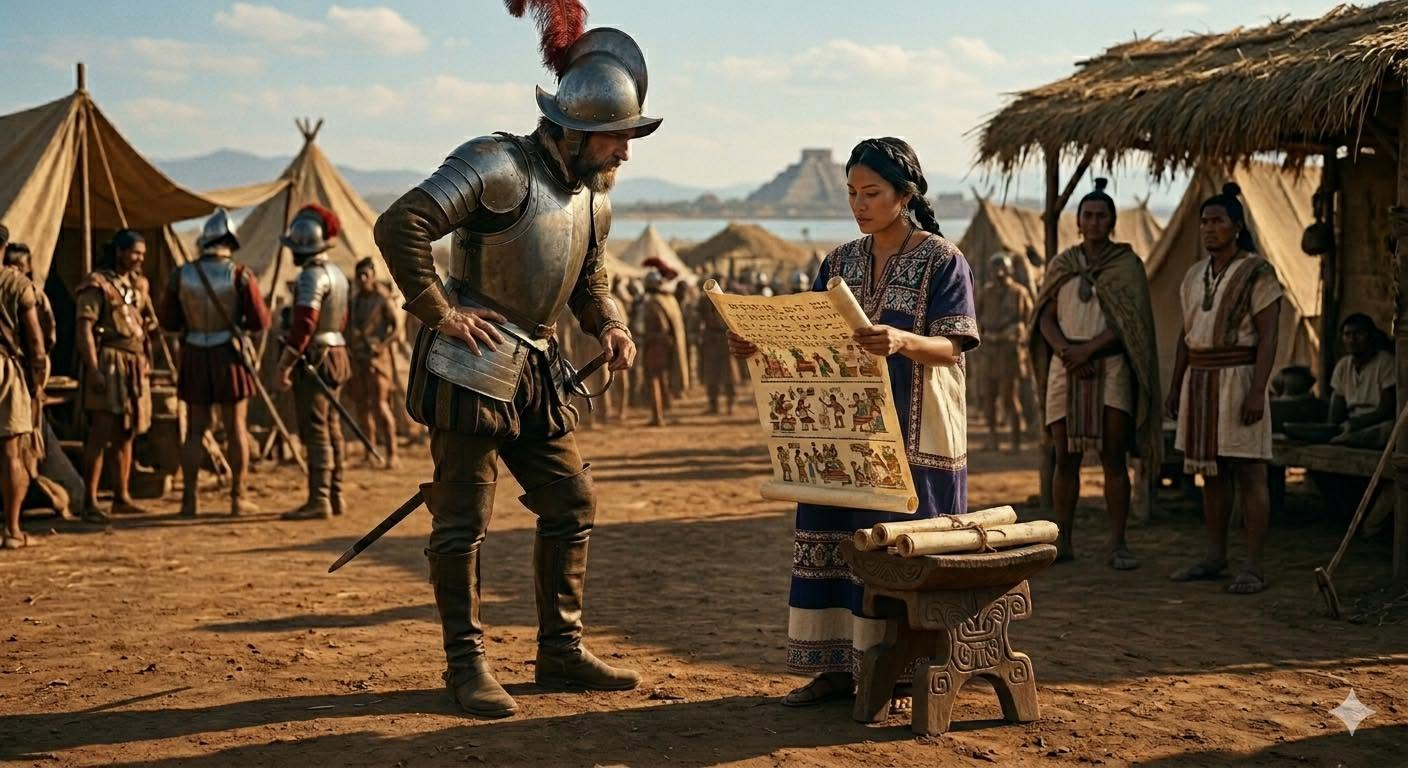
Born Nahua and raised speaking Nahuatl, she was later sold into captivity among Maya-speaking peoples, which is how she came to master both languages. When she was given to Cortés, she carried something more valuable than gold: the ability to move between worlds. She translated more than words. She translated political fractures, alliances, grievances, and danger that Cortés could never have read on his own.
She warned him of ambushes. She advised him on which factions to court and which to destroy. Eventually she also learned Spanish, becoming a direct voice for the entire campaign. Without her, Cortés was simply a confused foreigner waving a sword at people he did not understand.
An Outlaw With No Way Home
Here is the part most people skip. Cortés was an outlaw.
The Governor of Cuba, Diego Velázquez, revoked his charter before the fleet even sailed. Cortés ignored the order anyway and took the ships to the mainland. Then he made one of the boldest moves in the history of the Americas. He scuttled his own fleet at Veracruz, stripped it for parts, and removed any possibility of retreat.
His men could not sail home. Neither could he. If he returned empty-handed, the crown would execute him for treason. So his only path forward was handing King Charles V the biggest prize in the New World. He was not driven by vision. He was driven by desperation.
Why the Statues Stand Somewhere Else
So why does Cortés still get statues in Spain?
Because he wrote his own story. His letters to Charles V, the Cartas de Relación, framed every ambush and every borrowed victory as Christian valor and brilliant strategy. His soldier Bernal Díaz del Castillo wrote a chronicle that Western historians eagerly adopted, because it confirmed exactly the story they wanted to believe.
Mexico never bought it. You will not find statues of Cortés there. No streets, no monuments. Instead, monuments honor Cuauhtémoc, the last Mexica ruler who refused to surrender. The irony, of course, is that the Tlaxcalans, who arguably did more than anyone to bring down Tenochtitlan, spent generations labeled as traitors, even though the idea of a unified Mexico did not exist in 1519. They were protecting their own people from an oppressive empire. That is not betrayal. That is survival.
KT, Your Insider Guide
Cortés walked into a powder keg holding a box of matches. The powder had been building for decades, resentment, resistance, and the slow burn of tributary subjugation under Mexica rule. He did not engineer the explosion. He simply happened to be standing there when it went off.
That is the real story Mexico carries, and it runs all the way down to this peninsula too. Explore the culture and history behind Los Cabos at cabosfinest.com