

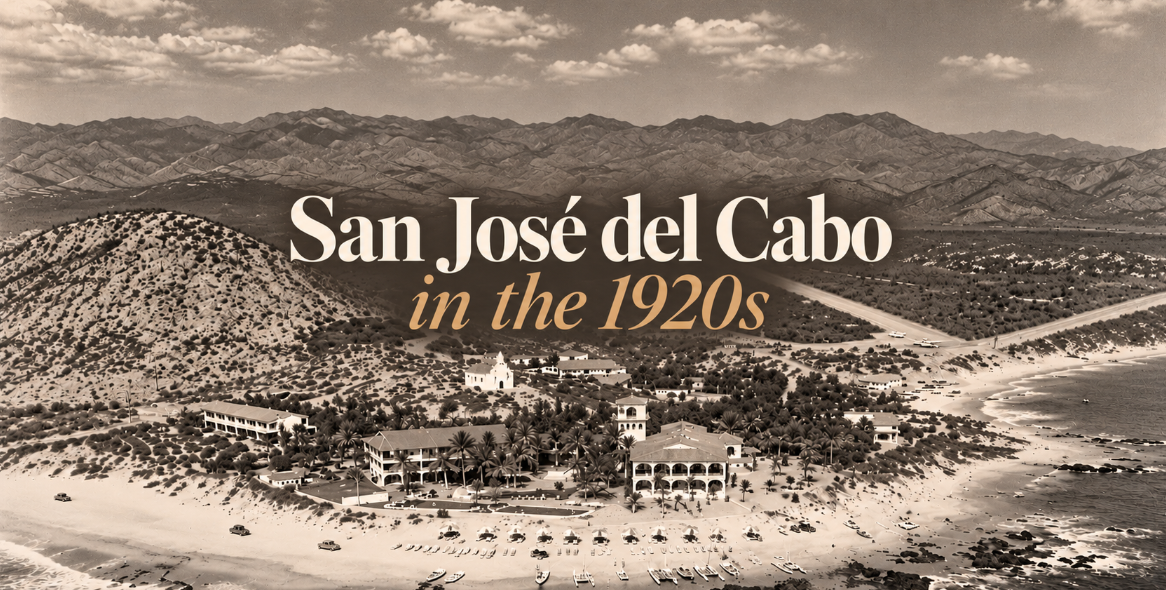
San José del Cabo in the 1920s: The Sugar Boom
Long before the boutique hotels and gallery crawls, San José del Cabo ran on sugarcane. Back in the 1920s, once the dust from the Revolution and a run of brutal droughts finally settled, this river valley turned into an agricultural machine. The river gave it good irrigation. Between 41 local mills, the valley was producing close to 700 tons of piloncillo, raw brown sugar, per year for export to the mainland. A remote cape outpost became a boomtown almost overnight.
And even though this place was as isolated as it gets, the modern world still found a way in. A rough dirt road connected San José to La Paz by 1920. All that sugar money also paid for a fast rebuild downtown after a brutal hurricane leveled much of it in 1918.
What Did the Sugar Boom Build in Downtown San José del Cabo?
The 1920s left a permanent mark on the historic core. The Palacio Municipal, originally built in 1891, received a serious post-hurricane facelift in the decade. The imported 1904 clock tower was restored, and that same courtyard is still there today, murals and all, telling the valley’s story to anyone who wanders in.
Plaza Mijares changed shape during this period as well. The mill owners and merchants who got rich off sugar built the thick adobe and brick homes around the square, high ceilings, shaded courtyards, all designed to survive a Baja summer. The plaza stopped being a dusty clearing and became an actual civic center. In addition, the mission church, nothing like the twin-spired version rebuilt in the 1940s, was a beat-up adobe structure the community kept patching after every flood and storm throughout the decade.
What Was La Voz del Sur?
La Voz del Sur ran along Zaragoza and Hidalgo and handled everything, including the piloncillo exports. It did well enough that by 1925 it was also the local Ford dealership, moving Model Ts and Model As to the sugar barons in town. In a community this isolated, a single general store that also sold cars says a great deal about how much money was moving through the valley at the time.
What Does the 1920s Sugar Boom Have to Do With the Art District Today?
Here is the part worth knowing before your next walk through the Art District. Those high-ceilinged galleries and restaurants with hidden courtyards on Zaragoza and Hidalgo are not some rustic-modern build-out. They are the original homes and warehouses of 1920s plantation owners. The thick adobe walls you see behind the art have been absorbing a century of Baja sun. Furthermore, they are still standing because the people who built them had both money and practical sense about what survives in a desert climate.
When you walk the Art District on a Thursday night, you are walking through old sugar money. The architecture is the evidence.
KT Insider Note
Most visitors to the Art District have no idea what they are walking through. The next time you step into one of those gallery spaces with the shaded courtyard and the ceiling that seems too high for a building this old, that is a 1920s sugar baron’s home. The piloncillo exports paid for it. The hurricane of 1918 shaped it. And the river valley that made it all possible is still visible at the estero a few blocks away. San José del Cabo has more layers than most people give it credit for.
KT, Your Insider Guide, Cabos Finest Real Estate , Facebook