

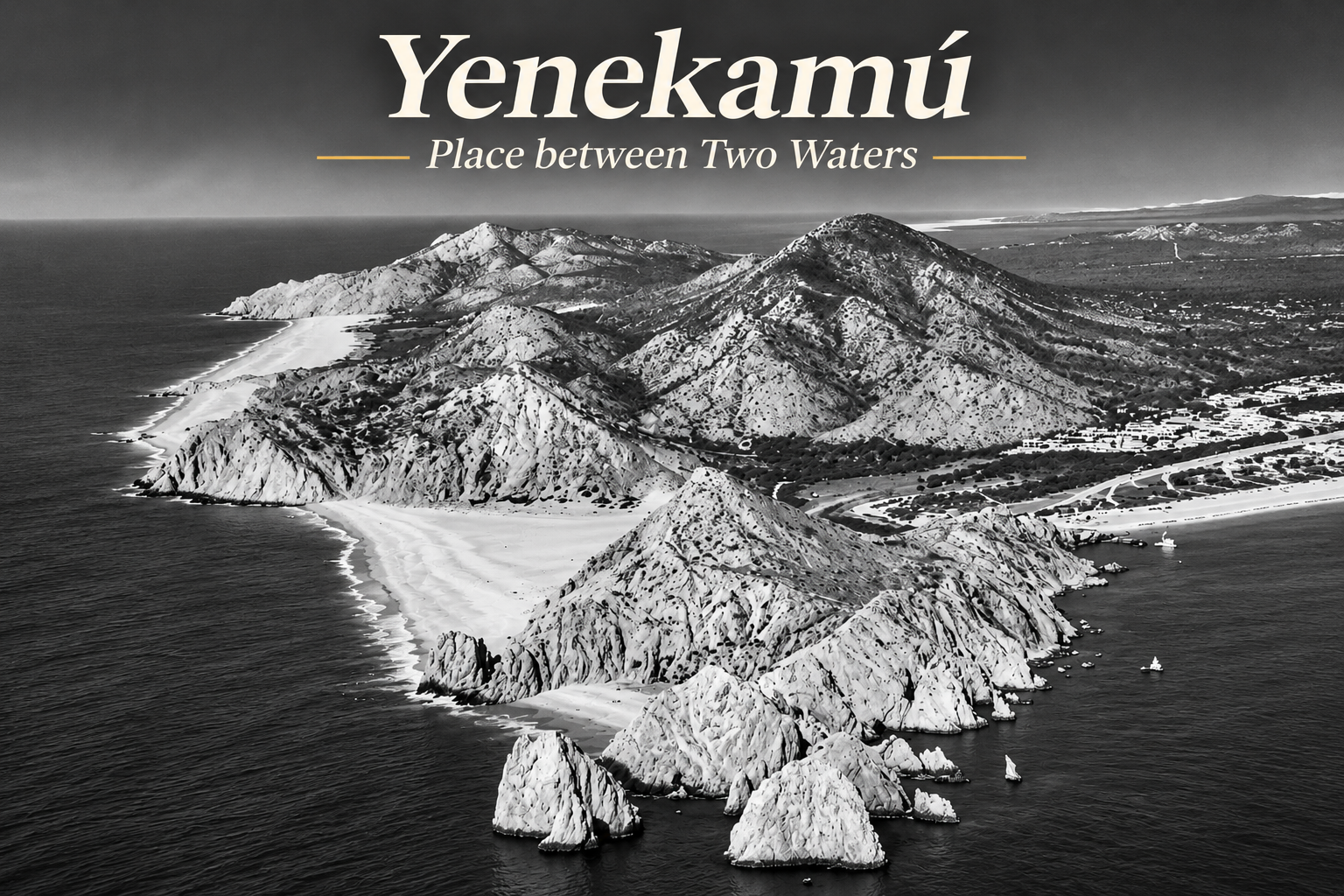
Yenekamú: The Pericú Name for Los Cabos
Anyone standing at Land’s End today sees the exact place the name describes. The granite spires of Los Arcos drop into the sea at the convergence of two oceans. Yenekamú, often written Yenecamú in early Spanish accounts, comes from the Pericú language. It translates to “place between two waters.” This is one of the oldest names attached to this coastline. It describes the meeting of the Pacific Ocean and the Gulf of California with more precision than most modern names manage.
Who Were the Pericú People of Los Cabos?
The Pericú occupied the southern tip of the Baja peninsula long before European ships arrived. Their territory ran from Todos Santos and La Paz down through the East Cape and Los Cabos. Furthermore, they also inhabited the islands of Espíritu Santo and Cerralvo. They were not a mainland-style indigenous group. They built their entire culture around the sea.
They constructed wooden rafts propelled by double-bladed paddles. Skilled free-divers harvested fish, shellfish, and other marine resources using harpoons and bone-tipped implements. The desert environment did not support traditional farming. So the Pericú followed a seasonal rhythm instead. They harvested wild pitahaya fruit and agave, hunted deer and small game with bows and arrows, and drew consistently from the resources of the two converging seas.
What Made the Pericú Distinct Among Indigenous Groups?
Early European observers noted that the Pericú looked unlike other native groups on the peninsula. They stood generally taller and had distinctive cranial features. Modern anthropologists have studied these differences in detail. Cranial morphology and genetic studies point toward possible ancient connections to South Pacific and Australasian populations. This differs from the northern continental migrations that account for most Native American ancestry. As a result, scientists continue to debate how the Americas were first populated, and the Pericú remain central to that conversation.
Their belief system centered on a creation deity named Niparaja. They built temporary shelters from branches and reeds, or used natural rock overhangs and caves along the coastline. Moreover, the Pericú had no fixed agricultural settlements. The land and sea provided what was needed, and the people moved accordingly.
What Happened to the Pericú After European Contact?
Spanish explorers and Jesuit missionaries arrived in the late 16th and 17th centuries. The encounter devastated the Pericú as a people. Disease, displacement, and the collapse of their seasonal patterns destroyed the population within generations. In addition, the Pericú Revolt of 1734 marked a brief period of organized resistance. However, the remaining population disappeared or absorbed into the colonial society shortly after.
The Pericú language did not survive into the modern era in any complete recorded form. Nevertheless, place names survived. Yenekamú remains embedded in the landscape at Land’s End. Añuiti, the Pericú name for San José del Cabo, translates to “place full of reeds.” Both names carry the linguistic memory of a people who understood this territory through the two seas, the desert, and the life found between them.
KT Insider Note
Los Cabos draws people for the views from Land’s End. Those same views held meaning for human beings thousands of years before the first resort appeared. The Pericú named the place for exactly what you see standing there today: two oceans meeting at a granite point. When you look at Land’s End, you look at Yenekamú. That context does not make the destination more complicated. It makes it more interesting.
KT, Your Insider Guide, Cabos Finest Real Estate , Facebook