

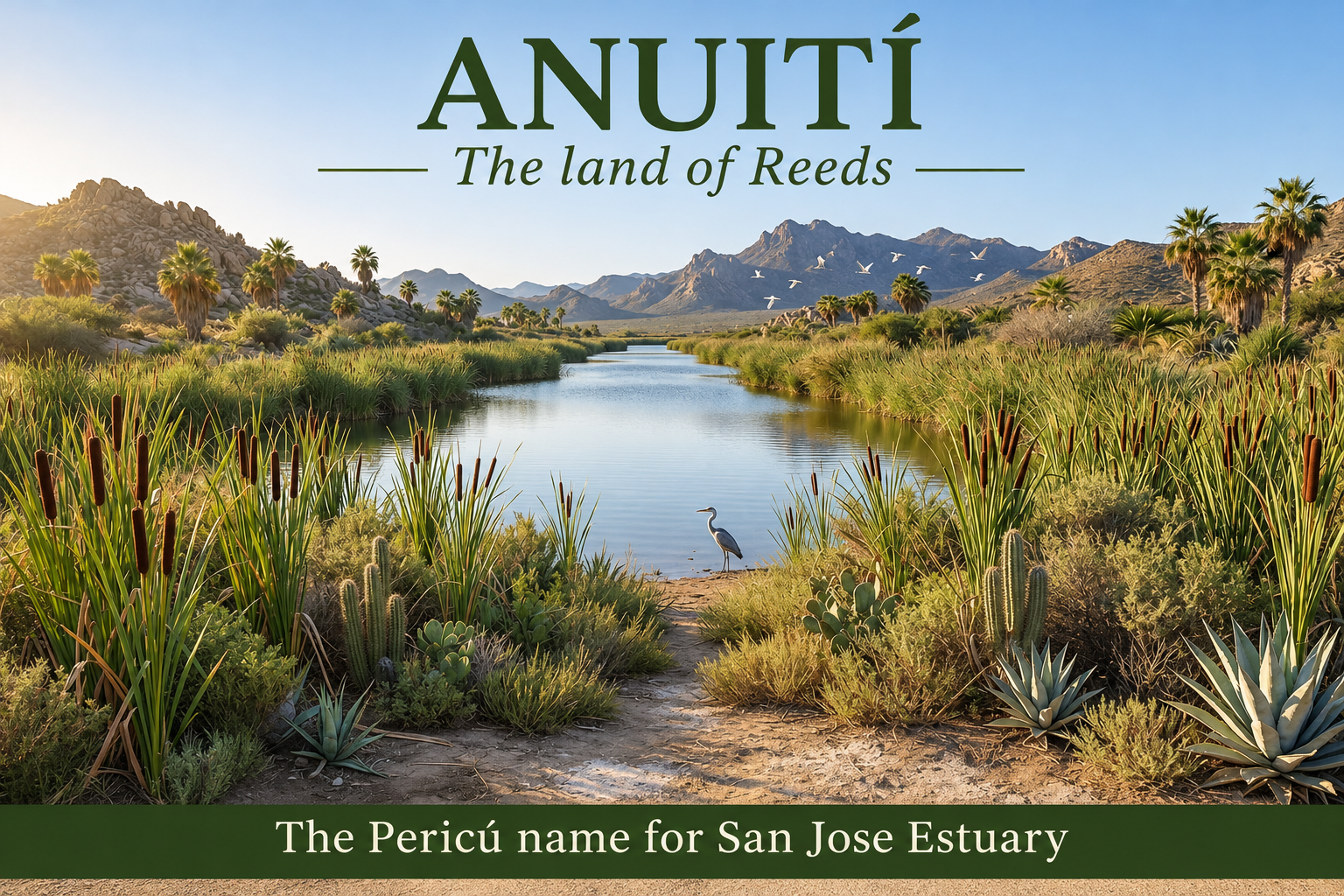
Añuiti: The Pericú Name for San José del Cabo
Before the hotels, the plaza, and the tourist corridor, the site of modern San José del Cabo had a name. The Pericú called it Añuiti, meaning “land of reeds.” The name came directly from the landscape: a desert oasis where the subterranean flow of the San José River meets the Gulf of California. That freshwater estuary, the third largest in Mexico, created a ribbon of tules, reeds, and fan palms cutting through the surrounding desert. The place existed as a living system long before any colonial map gave it a Spanish name.
What Was Añuiti Before the Spanish Arrived?
The Pericú who inhabited Añuiti were a maritime people. They built wooden rafts propelled by double-bladed paddles and harvested fish and shellfish through free-diving traditions unusual among coastal peoples of that era. The reeds of Añuiti supplied materials for shelters, basketry, and tools. The coastal lagoons and the estero provided a dependable anchor for daily life. Furthermore, the interior desert offered seasonal resources, wild pitahaya fruit, agave, and small game, but the estuary was the foundation.
The Pericú were also physically distinct from other native groups on the peninsula. Early European observers noted they stood taller and showed cranial features unlike neighboring peoples. Modern genetic studies have pointed toward ancient connections to South Pacific and Australasian populations, making the Pericú part of ongoing scientific debate about how the Americas were first settled.
How Did Añuiti Become San José del Cabo?
Spanish sailors knew the site long before missionaries arrived. The freshwater flow from the estuary made Añuiti a reliable stop for the Manila Galleons returning from Asia to Acapulco. Spanish records referred to it as Aguada Segura, the safe watering place. Moreover, that strategic value made the location a priority for the Jesuit mission system expanding southward through Baja.
On April 8, 1730, Jesuit missionary Nicolás Tamaral formally established the Mission of San José del Cabo Añuití near the beach and estuary. The mission system brought forced labor, cultural suppression, and direct attacks on Pericú social practices. In addition, smallpox and measles introduced through European contact had already cut the Pericú and Guaycura populations by roughly half within a generation. The mission was widely seen as part of that collapse.
What Was the Pericú Revolt of 1734?
Resentment built over years before it broke. The Jesuits targeted Pericú traditions, most notably the practice of polygamy, which the community regarded as tied to its social structure. The punishment of local leaders added pressure to an already fractured relationship. In October 1734, Pericú rebels killed missionary Lorenzo Carranco at Santiago. They then marched to San José del Cabo and killed Father Tamaral, dismantling the mission entirely.
The rebellion continued for nearly three years. As a result, Spanish forces eventually suppressed it, but the underlying conditions did not change. Disease continued to reduce the Pericú population through the mission decades that followed. By the early 19th century, the Pericú as a distinct people had all but disappeared.
What Remains of Añuiti Today?
The mission shifted locations several times after the revolt, moving between the coast and the inland site of San José Viejo before secularizing in 1830. The modern city grew outward from that colonial foundation. However, the estuary survived. The protected San José estuary that runs along the edge of the hotel zone today is the same freshwater system the Pericú built their world around. The reeds are still there. The water still moves. Añuiti did not entirely disappear. It simply got a different name.
KT Insider Note
Most visitors to San José del Cabo walk the art district, eat at the plaza restaurants, and enjoy the town without knowing they are standing on the site of one of the most significant indigenous rebellions in Baja California history. The estuary at the edge of the hotel zone is not just a nature reserve. It is the reason this place existed at all. The Pericú chose Añuiti for the same reason the Spanish did: fresh water in a desert landscape is worth everything. That has not changed.
KT, Your Insider Guide, Cabos Finest Real Estate , Facebook